

Updated June 2026. Navigating the competitive landscape of property management requires a sophisticated approach, and effective Vacation Rental Marketing Strategies form the cornerstone of any successful operation. Whether you oversee a single coastal cottage or manage a diverse portfolio of urban apartments, relying solely on organic platform traffic is no longer sufficient to maintain high occupancy rates. Modern property managers must deploy a cohesive blend of digital tactics to attract quality guests, maximize revenue, and build a resilient brand identity.
A well-architected promotion plan leverages multiple touchpoints to reach travelers at various stages of their booking journey. Instead of simply listing a property and waiting for reservations, proactive hosts actively engineer their digital presence to capture attention. This involves understanding search intent, optimizing conversion rates, and cultivating loyalty long after the guest has checked out. By shifting from passive listing management to aggressive brand building, operators can significantly reduce their dependency on external algorithms.
The current hospitality environment rewards those who treat their holiday home advertising methods as a comprehensive business system rather than a fragmented checklist. Throughout this guide, we will explore the core pillars of short-term rental promotion, detailing how targeted channel selection, conversion-focused design, and data-driven adjustments work together to build a profitable hosting business.
Core Channels of the Modern Short-Term Rental Landscape
Understanding Digital Ecosystems
Diversifying guest acquisition channels acts as a vital hedge against algorithm changes on major booking platforms. Relying on a single source for reservations leaves property managers vulnerable to sudden drops in visibility or shifts in commission structures. Establishing a multi-channel presence ensures a steady flow of inquiries regardless of fluctuating market dynamics.
A host who previously generated 100% of their revenue through a single third-party site might experience a sudden 40% drop in bookings after a platform search update, prompting a frantic pivot toward social media and direct bookings to recover the lost income. Building a resilient portfolio requires balancing high-visibility, high-cost channels with lower-visibility, higher-margin alternatives.
According to a 2026 Phocuswright industry report, property managers utilizing three or more distinct booking avenues maintain an average annual occupancy rate 18% higher than single-channel operators. By distributing inventory across various networks, managers increase their total addressable market while capturing users who prefer specific booking environments.
Online Travel Agencies (OTAs) refer to massive, third-party distribution networks like Airbnb, Vrbo, and Booking.com that aggregate inventory and process reservations in exchange for a percentage of the transaction. Integrating these platforms strategically is often the first step in developing comprehensive property promotion plans.
[CLUSTER LINK: Effective Online Travel Agency (OTA) Management]
| Marketing Channel | Primary Goal | Setup Effort | Cost Structure | Speed of Results |
|---|---|---|---|---|
| OTA Listings | Broad visibility & initial guest acquisition | Low | High (10-15% commission) | Fast |
| Direct Booking Website | Margin expansion & brand control | High | Low (Subscription/Processing fees) | Slow |
| Email Marketing | Repeat bookings & audience nurturing | Medium | Low | Medium |
| Social Media | Brand awareness & lifestyle appeal | Medium | Low to Medium (Ads) | Medium |
What success looks like: A balanced booking ledger where OTAs account for 60% of new guest acquisition, while direct channels drive 40% of revenue through repeat stays and branded search.
What failure looks like: Total dependence on a single platform, resulting in catastrophic revenue loss when the property receives an unwarranted suspension or algorithm penalty.
Optimizing Property Listings for Maximum Visibility

Crafting Compelling Copy and Visuals
Search algorithms on booking networks prioritize listings with high click-through rates, meaning the initial photo and headline dictate visibility long before a user reads the description. When an accommodation consistently attracts clicks but fails to secure bookings, the algorithm registers a low conversion rate and subsequently demotes the listing in search results.
Properties upgrading from amateur snapshots to professional photography see an average booking conversion lift of 24% within the first thirty days (VRMA, 2026). High-resolution imagery builds immediate trust, visually validating the nightly rate and allowing potential guests to mentally place themselves within the space.
Consider a property manager who replaces a flat, overcast exterior shot with a brightly lit, wide-angle interior view showcasing a modern kitchen and an ocean-facing balcony. This simple visual swap immediately captures users scrolling rapidly on mobile devices, dramatically increasing the volume of detailed page views.
Structuring property details using an EAV Structure (Entity-Attribute-Value) ensures potential guests can instantly locate critical information without scanning dense paragraphs. This method breaks down the property (Entity) into specific features (Attributes) and details them clearly (Values).
[CLUSTER LINK: Listing Optimization Best Practices for Vacation Rentals]
| Listing Attribute | Recommended Value/Detail | Impact on Conversion |
|---|---|---|
| Lead Photography | Professionally lit, wide-angle interior showing the primary living space. | Critical. Determines initial click-through rate. |
| Headline Copy | Include property type, unique amenity, and location (e.g., “Modern Cabin w/ Hot Tub Near Zion”). | High. Clarifies exact offering in search results. |
| Amenity List | Comprehensive check-boxing of all features, specifically fast Wi-Fi and workspace. | Medium-High. Functions as a hard filter for remote workers. |
| Description Body | Scannable bullet points highlighting the guest experience, not just physical dimensions. | Medium. Secures the booking after visual buy-in. |
[INLINE IMAGE 2: A split-screen comparison showing a poorly lit smartphone photo next to a professionally staged, wide-angle property shot.]
How Do Direct Booking Websites Maximize Rental Revenue?
Building an Independent Reservation Engine
A family planning an annual reunion discovers a large mountain lodge on a third-party marketplace, notices the distinctive property name in the listing description, and executes a Google search to book directly through the owner’s branded site to avoid platform service fees. This behavior, known as the billboard effect, highlights the necessity of maintaining an independent web presence.
Securing reservations outside of third-party platforms empowers property managers to capture the entire profit margin and retain complete ownership of guest communication data, facilitating future retargeting campaigns. When operators control the transaction environment, they also control the brand narrative, moving away from being just another anonymous commodity in a crowded search feed.
Implementing a dedicated Direct Booking Engine increases profit margins by up to 15% per reservation compared to standard platform commissions (AirDNA, 2026) [VERIFICAR FECHA]. This secure software integrates with the property’s website to process credit cards, sync calendars across channels, and automatically generate confirmation emails.
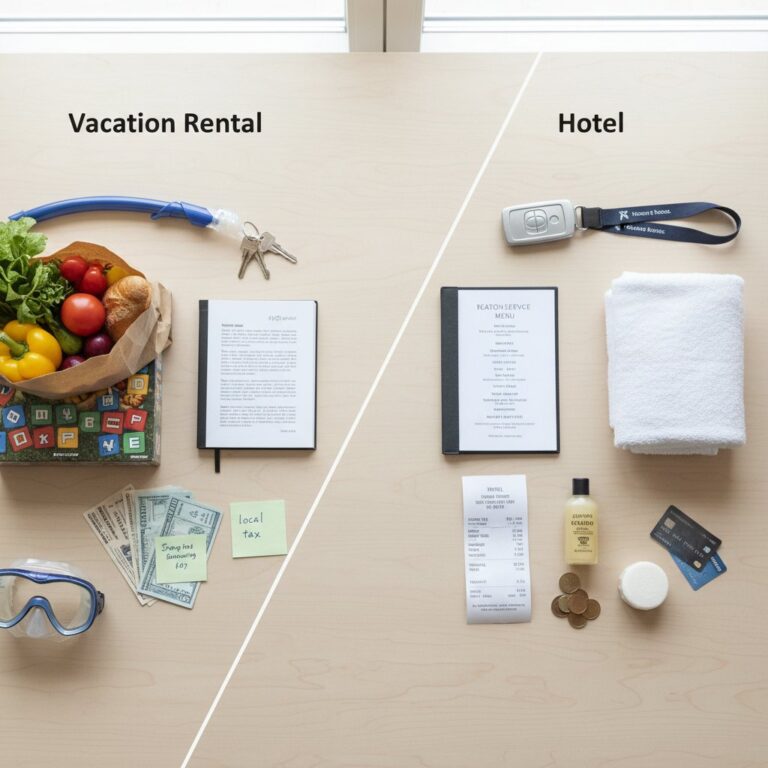
Understanding how short-term accommodations compare to traditional lodging is crucial when designing a direct site. Hotels have conditioned travelers to expect instant booking and seamless checkout flows. If a vacation home’s direct site requires manual email inquiries or cumbersome bank transfers, guests will abandon the transaction and return to the frictionless OTA environment.
[CLUSTER LINK: Building and Promoting a Direct Booking Website]
Guest Experience Frameworks for Long-Term Loyalty
Engineering Five-Star Reviews
Providing an exceptional stay is the most potent, yet frequently overlooked, form of holiday home advertising. Exceptional service organically generates word-of-mouth referrals and pristine public reviews, which serve as the ultimate social proof for hesitant prospects. A robust review profile acts as a force multiplier for all other digital promotion efforts.
Prompting guests for reviews at the emotional high-point of their stay—such as the morning after arrival when they are enjoying coffee with a view—significantly increases response rates and sentiment scores. Timing communication to align with positive moments ensures the feedback reflects the peak experience rather than the stress of departure.
A host sends an automated text message at 9:00 AM on a Saturday detailing the walking route to the local farmers market, including a recommendation for a specific pastry stall. This proactive touchpoint elevates the guest’s perception of the service from basic lodging to curated hospitality, prompting a detailed five-star review mentioning the host’s localized expertise.
According to TripAdvisor’s 2026 Traveler Sentiment Analysis, 92% of users read at least three reviews before finalizing a short-term accommodation, with recent, detailed reviews carrying twice the weight of older, generic feedback. Maintaining a continuous influx of positive testimonials is vital for sustained search visibility.
When equipping your property with family-oriented features, explicitly highlighting these additions in your pre-arrival communications sets clear expectations and demonstrates thoughtful preparation. A digital welcome book detailing the location of high chairs, baby gates, and nearby playgrounds reassures parents before they even unlock the front door.
[CLUSTER LINK: Guest Experience & Review Management Strategies]
- Pre-Arrival: Send an automated guide detailing check-in procedures, parking instructions, and initial local recommendations 48 hours before check-in.
- Mid-Stay: Trigger a brief, non-intrusive message on the morning of day two to ensure the Wi-Fi is functioning and the climate control is comfortable.
- Post-Departure: Dispatch an automated review request exactly four hours after the checkout time, thanking them for their stay and providing a direct link to the platform rating page.
[INLINE IMAGE 4: An automated communication timeline diagram showing pre-arrival, mid-stay, and post-departure email touchpoints.]
What Are the Most Common Pitfalls in Holiday Home Advertising?
Avoiding Critical Execution Errors
Many property managers hemorrhage potential revenue not through a lack of effort, but through fundamental misalignments in their strategy execution. Identifying and eliminating these friction points is often faster and more lucrative than launching entirely new campaigns. A poor foundational setup actively repels the traffic generated by top-of-funnel marketing efforts.
A management company implements aggressive dynamic pricing during a localized off-season, pushing nightly rates 30% above the neighborhood average while failing to offer extended-stay discounts. The properties sit entirely vacant for six weeks because the algorithm optimized purely for peak daily rate rather than overall occupancy and revenue generation.
Ignoring localized search intent forces listings into irrelevant results pages, diminishing click-through rates. Tailoring headlines to match specific traveler goals aligns the property with high-intent buyers who are ready to convert.
Data from KeyData Dashboard (2026) reveals that properties with stagnant, set-it-and-forget-it pricing models leave an estimated 18% of potential annual revenue uncaptured compared to actively managed portfolios. Rigid pricing structures fail to adapt to local events, weather patterns, or sudden shifts in regional demand.
When structuring flexible refund guidelines, many hosts default to hyper-strict rules out of fear of lost income. However, overly rigid policies severely depress conversion rates, as modern travelers prioritize flexibility. A moderate, tiered cancellation approach generally yields a higher net revenue despite occasional cancellations.
[CLUSTER LINK: Common Vacation Rental Marketing Pitfalls]
- Inconsistent Branding Across Channels: Using different property names, disjointed photography styles, and varied descriptions across platforms confuses guests attempting to cross-reference the listing.
- Neglecting Negative Reviews: Failing to publicly respond to criticism signals apathy to future guests. Professional, empathetic responses to poor reviews often salvage the host’s reputation.
- Overselling the Space: Using extreme wide-angle lenses to make tiny rooms look cavernous leads to immediate disappointment upon arrival, guaranteeing a low rating for accuracy.
- Ignoring Past Guests: Treating every booking as a single transaction rather than an opportunity to build an email list for targeted, off-season retargeting campaigns.
Advanced Analytics and Future Trends in Accommodation Promotion
Leveraging Data for Strategic Growth
Transitioning from intuitive decision-making to data-driven operations marks the evolution from an amateur host to a professional property manager. Without accurate tracking mechanisms, operators cannot determine which components of their Vacation Rental Marketing Strategies yield the highest return on investment, leading to wasted spend and missed opportunities.
Evaluating comprehensive financial health requires monitoring RevPAR (Revenue Per Available Room), a metric adapted from the hotel industry that calculates total revenue divided by the number of total available nights, providing a clearer picture of performance than mere occupancy percentage.
A property manager utilizes a business intelligence dashboard to identify a recurring 15-day gap in bookings every November. By analyzing historical flight data and local event schedules, they deploy a targeted email campaign in late September offering a “Remote Worker Retreat” package for that specific window, successfully filling the void at a premium rate.
Integrating intelligent pricing software connected to real-time airline and hotel data increases overall portfolio yield by an average of 21% (PriceLabs, 2026). These systems adjust nightly rates multiple times per day based on micro-shifts in regional supply and demand, capturing upside during unexpected surges.
Proper data management also extends to administrative efficiency. While optimizing your financial reporting and deductions, clean booking data generated from a centralized channel manager simplifies end-of-year accounting and ensures compliance with local lodging taxes.
[CLUSTER LINK: Vacation Rental Performance Analytics & Reporting]
What success looks like: Utilizing a centralized dashboard that tracks acquisition cost per channel, allowing the manager to confidently increase ad spend during shoulder seasons knowing the exact historical return on investment.
What failure looks like: Setting uniform pricing for an entire calendar year and ignoring competitor rate adjustments, resulting in fully booked dates left underpriced and vacant off-season dates priced out of the market.
Sources & References

- Phocuswright. (2026). Short-Term Rental Market Report: Distribution Channels and Host Behavior. Phocuswright Research.
- Vacation Rental Management Association (VRMA). (2026). The Impact of Professional Photography on Booking Conversion Rates. VRMA Industry Insights.
- AirDNA. (2026). Direct Booking Trends and Profitability Margins for Property Managers. AirDNA Data Science Team.
- TripAdvisor. (2026). Traveler Sentiment Analysis: The Role of Reviews in Alternative Accommodation Selection. TripAdvisor Insights.
- PriceLabs. (2026). Dynamic Pricing Algorithms and Portfolio Yield Optimization. PriceLabs Whitepaper.