

Vacation Rental vs Hotel: Full Cost Comparison
Affiliate disclosure: This article may contain affiliate links. Recommendations are independent and editorially driven.
Is a vacation rental or hotel cheaper?
A hotel is generally cheaper for solo travelers and short stays of one to two nights due to the absence of cleaning fees. Conversely, a vacation rental is cheaper for groups of four or more guests and extended stays exceeding five nights, as it allows groups to split a single property cost and amortize one-time cleaning fees over a longer duration.
Deciding between a vacation rental and a hotel is often the first major hurdle in vacation planning. While both offer a place to rest your head, the underlying cost structures, amenities, and overall experience can differ dramatically. Beyond the advertised daily rate, understanding the full cost comparison involves delving into a complex web of hidden fees, service charges, dining expenses, and the often-overlooked value of space and privacy. This comprehensive guide will meticulously break down every financial aspect, from base rates and short-term rental occupancy taxes to hotel resort fee litigation and the average cost per square foot comparison, to help you make an informed decision for your next trip.
Understanding Base Rates: The Starting Point
Decoding Hotel Room Rates
Hotel room rates are typically quoted per night, per room, regardless of single or double occupancy (though additional guests may incur nominal charges). These rates can fluctuate wildly based on seasonality, location, demand, and star rating. A standard hotel room in a major metropolitan area might range from $150 to $400 USD per night, while luxury accommodations can easily exceed $1,000. It’s crucial to remember that the quoted rate is just the foundation; various taxes and potential add-ons will significantly inflate the final bill.
Vacation Rental Nightly Rates
Vacation rentals, such as those found on platforms like Airbnb or Vrbo, also quote a nightly rate. However, this rate is often for the entire property, regardless of the number of occupants (up to the stated maximum). This is a critical distinction, as it allows groups to effectively split the cost of accommodation, making a vacation rental remarkably cost-effective for families or multiple couples traveling together. Nightly rates for vacation rentals are influenced by similar factors as hotels: location, size, amenities, and time of year. A multi-bedroom rental might appear more expensive per night than a single hotel room, but the per-person cost can be substantially lower.
The flexibility of vacation rentals to accommodate more people for a single nightly rate is one of their most compelling financial arguments. For instance, a $300/night rental for a family of four shakes out to $75 per person, whereas two hotel rooms at $150 each would cost $300, or $75 per person, but with far less space and fewer amenities.
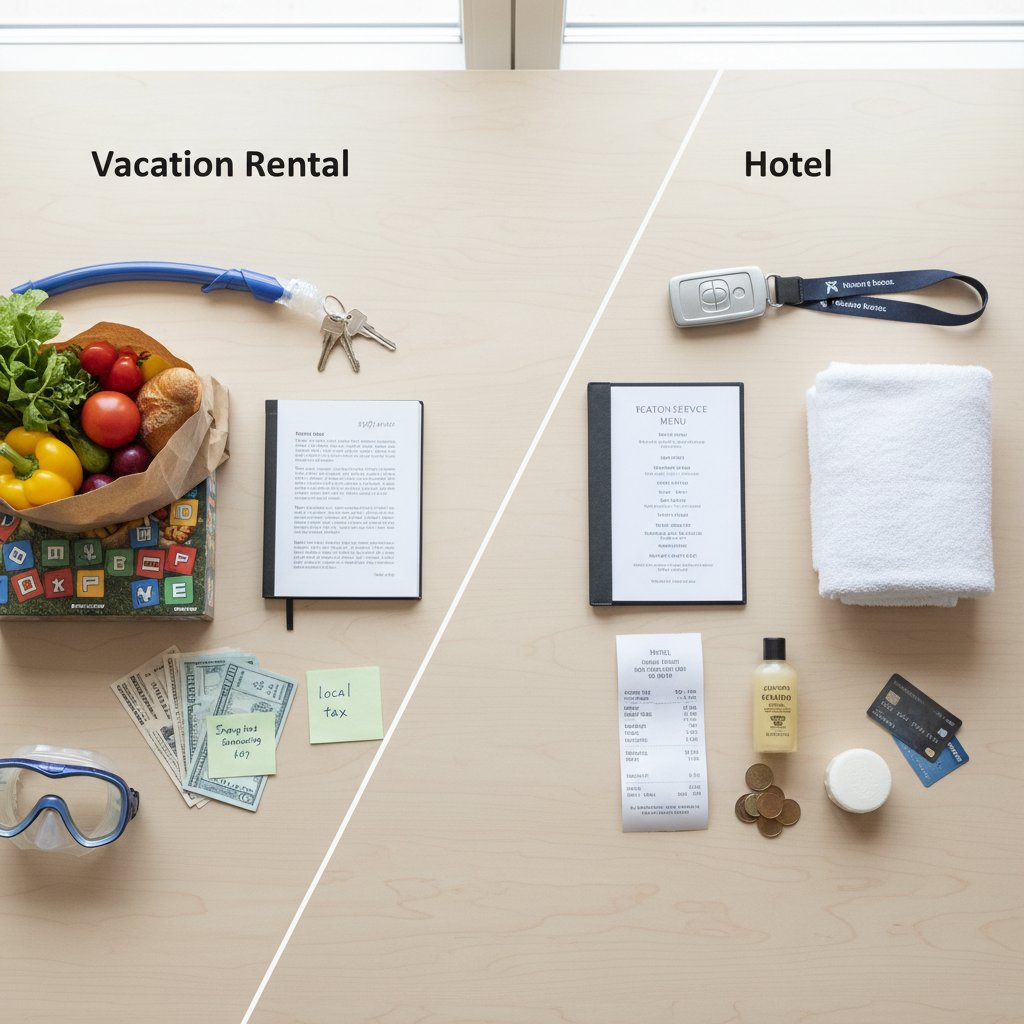
[INLINE IMAGE 1: place after second H2 | alt=”A side-by-side cost breakdown graphic comparing hotel resort fees vs Airbnb cleaning fees.”]
Navigating Transactional Fees and Hidden Charges
This is where the advertised prices often diverge significantly from the final payment. Both hotels and vacation rentals have their own unique set of additional fees that can catch unsuspecting travelers off guard.
Hotel Ancillary Charges
Resort Fees and Facility Charges
Perhaps the most notorious hotel hidden fee is the resort fee or facility charge. These mandatory daily fees, which can range from $20 to $100+ per night, are often not included in the initial room rate. Hotels defend them as covering “amenities” like Wi-Fi, fitness center access, and pool use, even if guests don’t utilize them. The legality and transparency of hotel resort fee litigation have been a hot topic, with many consumer advocacy groups arguing they are deceptive advertising. Always scrutinize the fine print for these charges before booking a hotel, as they can add hundreds to a week-long stay and are rarely waivable.
Taxes and Other Potential Surcharges
Beyond resort fees, hotels levy various taxes, including local occupancy taxes, state sales tax, and sometimes tourism assessments. These can add another 10-20% to the base rate. Additionally, be aware of charges for parking (often $20-70 per day in urban areas), pet fees, mini-bar consumption, and in-room movie rentals. Early check-in or late check-out might also come with a significant extra cost.
Vacation Rental Service and Cleaning Fees
Booking Platform Service Commissions
Platforms like Airbnb and Vrbo charge booking platform service commissions directly to the guest, typically ranging from 5% to 15% of the subtotal (nightly rate + cleaning fee). This fee helps the platform cover operational costs, customer support, and payment processing. While transparently displayed before booking, it’s an additional cost to factor in.
Cleaning Fees Explained
A major point of contention for many renters, cleaning fees are one-time charges levied by hosts to cover the cost of cleaning the property after your stay. These fees can range from $50 for a small studio to several hundred dollars for a large multi-bedroom home. The impact of the cleaning fee is directly related to the length of your stay: a $100 cleaning fee on a one-night stay effectively doubles the nightly rate, whereas on a seven-night stay, it adds only about $14 per night. This is why vacation rentals often favor longer stays, as the cleaning fee is amortized over a longer duration, reducing its per-night impact significantly.
Management and Linen Fees
Some vacation rentals, especially those managed by professional companies, might include additional “management fees” or “linen fees.” These are less common than cleaning fees but it’s important to check the breakdown before confirming your booking. Similar to hotels, vacation rentals are also subject to local and state short-term rental occupancy taxes, which will be added to your total.
Hidden Fees Breakdown: Hotels vs. Vacation Rentals
| Expense Attribute | Hotel (Typical Range) | Vacation Rental (Typical Range) | Notes |
|---|---|---|---|
| Resort Fee / Facility Charge | $20 – $100+ per night (Mandatory) | N/A | Often presented as covering amenities, rarely optional. |
| Booking Platform Service Commission | N/A | 5% – 15% of subtotal (Mandatory) | Varies by platform and booking value. |
| Cleaning Fees | N/A (Included in staff wages) | $50 – $400+ per stay (One-time) | Significantly impacts short stays. Amortizes over longer stays. |
| Parking Fees | $20 – $70+ per day (Optional, location dependent) | Free (Private driveways) or market rates (Street/Garage) | Major factor in urban hotels; often free at rentals. |
| Pet Fees | $25 – $200+ per stay/night (Optional) | $30 – $250+ per stay (Optional, host-dependent) | Check individual policy; some hotels/rentals are pet-free. |
| Early Check-in/Late Check-out | $50 – Full Night’s Rate (Optional) | Rarely available or negotiable with host | Less flexible with rentals due to strict cleaning schedules. |
| Local & State Occupancy Taxes | 10% – 20% of room rate | 8% – 18% of nightly rate + fees | Mandatory for both, rates vary by jurisdiction. |
Dining and Food Costs: Kitchen vs. Room Service
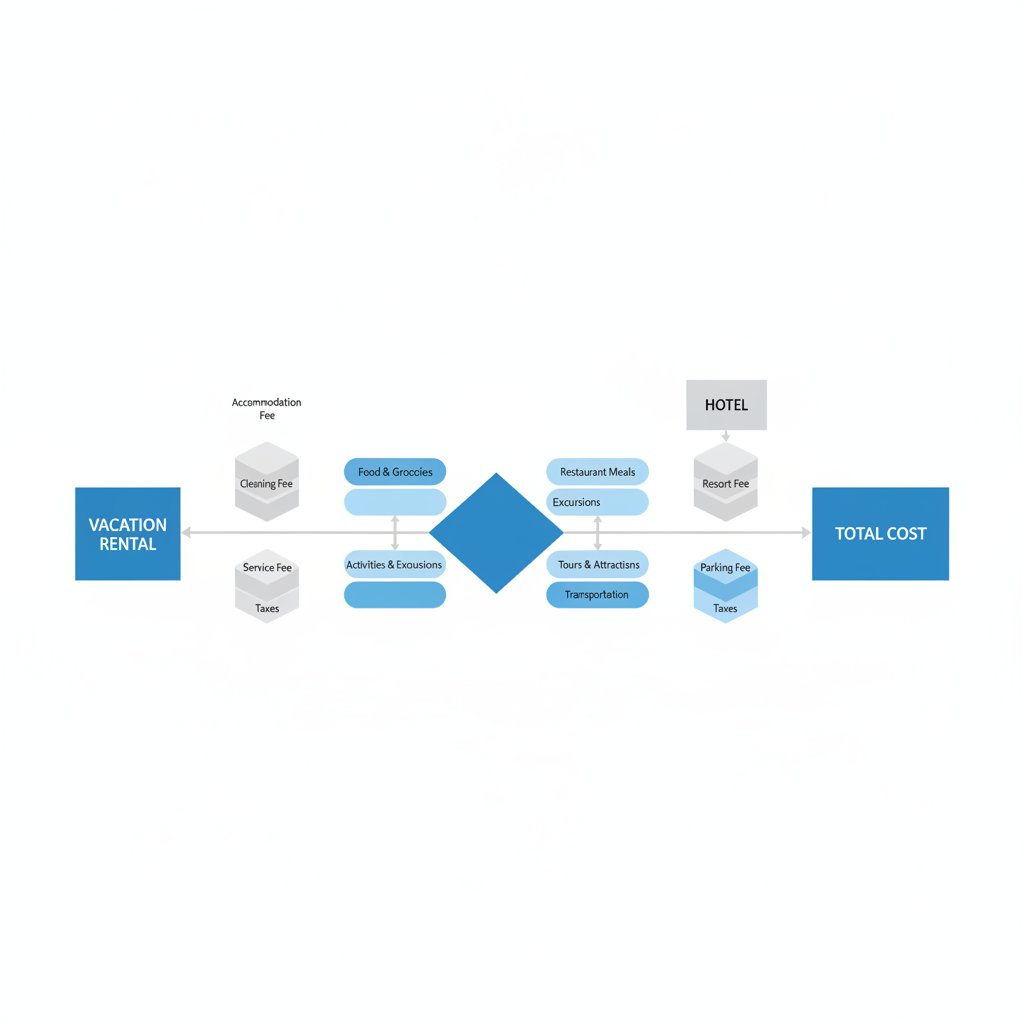
One of the most significant cost differences between a hotel and a vacation rental emerges when examining food expenses. This often overlooked factor can drastically swing the budget in one direction or another, especially for longer trips or larger groups.
Hotel Dining: Convenience at a Premium
Staying in a hotel often means relying on restaurants, room service, or nearby eateries for every meal. While convenient, this comes at a premium. An average breakfast at a hotel restaurant might cost $20-40 per person. A typical lunch downtown could be $15-30, and dinner easily $40-80 per person, especially with drinks. For a family of four, eating out three times a day can quickly add $200-400 to the daily budget. Complimentary breakfasts, sometimes offered by mid-range hotels, can offset this slightly, but they rarely cover the entire daily food cost.
The Food Amortization Factor in Hotels
In a hotel setting, there’s little to no ability to amortize food costs. Every meal is a transactional expense. While some hotels offer package deals that include meals, these are often more expensive than a la carte dining for budget-conscious travelers. The convenience of having myriad dining options at your fingertips is undeniable, but it’s essential to budget generously for these expenses.
Vacation Rental Kitchen: The Budget Game-Changer
The primary advantage of a vacation rental, from a culinary perspective, is the often fully equipped kitchen. This allows guests to prepare their own meals, significantly subsidizing meal costs compared to dining out consistently. A trip to a local grocery store for $100-200 could cover several days’ worth of meals for a family, a fraction of what restaurant dining would cost. This is particularly beneficial for travelers with dietary restrictions or young children.
Calculating Average Daily Food Costs: Hotel vs. Rental
- Hotel (Dining Out): For a family of four, conservatively estimate $150-250 per day for three meals, excluding snacks and drinks. Over a week, this could easily be $1,050 to $1,750. This is a crucial element of the full cost comparison, often pushing the vacation rental into a more financially attractive bracket, even with higher initial rental fees.
- Vacation Rental (Cooking In): For the same family of four, a grocery budget of $75-150 per day for cooking most meals, plus occasional dining out, is a reasonable estimate. Over a week, this translates to $525-$1,050. The savings are substantial and can often offset cleaning fees and service charges, particularly for extended stays.
The freedom to make a quick breakfast, pack lunches for day trips, or enjoy a home-cooked dinner without the added cost of restaurant markups is a major financial incentive for choosing a vacation rental. This “food amortization factor” is a high-weight entity in the overall savings calculation.
On-Site Amenities and Services
Beyond where you sleep and eat, the amenities available and their associated costs can materially impact your budget.
Hotel Amenities: Often Included, Sometimes Charged
Hotels typically boast a range of amenities such as pools, fitness centers, business centers, and concierge services. While these are often included in the resort fee (if applicable) or the base rate, some services still incur separate charges. Wi-Fi, once a complimentary perk, can sometimes be an extra daily fee for premium speeds. Laundry services, either self-service or valet, are almost always additional and can be quite expensive.
Laundry Costs Comparison
- Hotel Laundry: A hotel valet laundry service can charge several dollars per item, making it an unsustainable option for anything more than a few garments. A self-service laundry facility within a hotel might charge $3-7 per wash/dry cycle, plus detergent. For a family, budgeting for laundry at a hotel can add $50-100+ to a week’s stay if done regularly.
- Vacation Rental Laundry: Many vacation rentals come equipped with in-unit washers and dryers, allowing guests to do laundry for the cost of detergent (or sometimes even with complimentary detergent provided by the host). This can save a significant amount of money, especially for families or longer trips, by eliminating expensive hotel laundry costs and reducing the amount of luggage needed. The ability to do laundry freely is a prime example of how vacation rentals subsidize long-term comfort and cost-efficiency.
Vacation Rental Amenities: Home Away From Home
Vacation rentals vary widely in amenities, from basic to luxurious. Many include full kitchens, multiple bedrooms and bathrooms, private outdoor spaces, and, as mentioned, in-unit laundry. Some high-end rentals might offer private pools, hot tubs, or game rooms. While these amenities are typically “included” in the nightly rate, understanding what is provided versus what you might need to purchase (e.g., specific toiletries, pantry staples) is important. The “cost” here is often in what you don’t have to buy or pay extra for, enhancing both value and convenience.
[INLINE IMAGE 2: place after fourth H2 | alt=”Vacation Rental vs Hotel: Full Cost Comparison comparison illustration”]
Space, Privacy, and Group Travel Dynamics

Beyond the direct monetary costs, the value of space and privacy, particularly for groups, is a significant, albeit often qualitative, factor in this full cost comparison.
Hotel Limitations: Cramped Quarters and Limited Privacy
Hotel rooms are typically designed for one or two occupants, with limited living space. For families or groups, this often means booking multiple rooms or opting for suites, which come at a much higher price point. Even connecting rooms might lack a true communal gathering space. Privacy can be limited, and the constant presence of other guests, housekeeping, and hotel staff can detract from a relaxed vacation experience. This lack of space can lead to a “high stress score” for larger parties, even if the per-person monetary cost might seem appealing initially.
Group Rate Break-Even Analysis for Hotels
For groups, booking multiple hotel rooms often incurs independent fixed costs per room (multiple resort fees, taxes, etc.), leading to a rapidly escalating total. The benefit of “group rates” sometimes offered by hotels usually applies to large conventions or events and doesn’t always translate into significant savings for a typical family or friends trip. This makes the hotel option less efficient for cost-sharing among multiple individuals.
Vacation Rental Advantages: Ample Space and Enhanced Privacy
Vacation rentals excel in offering ample living space, often including multiple bedrooms, bathrooms, a living room, dining area, and sometimes a private yard or balcony. This is particularly advantageous for families with children, providing separate sleeping areas and common spaces for relaxation without feeling constrained. The enhanced privacy of a whole home or apartment can significantly improve the quality of the vacation experience. This allows groups to foster a more relaxed environment, essential for a fulfilling trip.
Cost-Sharing and Per-Person Savings
The ability to share the cost of a single accommodation among multiple individuals or families is a cornerstone of the vacation rental’s financial appeal. For example, a 3-bedroom rental costing $500 per night for six people is only about $83 per person per night. To match the space and amenities, six people might need three hotel rooms at $200 each, totaling $600 per night, or $100 per person, without the shared living areas or kitchen. This effective cost per square foot comparison often favors vacation rentals for larger groups.
The emotional and practical value of having communal spaces to cook, dine, and relax together should not be underestimated when comparing the overall vacation experience and value proposition. This is where vacation rentals truly shine for social travel.
The Break-Even Matrix Formula: When Does a Rental Become Cheaper?
Understanding the exact point at which a vacation rental becomes more cost-effective than a hotel is a crucial part of our full cost comparison. This “break-even matrix formula” helps travelers determine the optimal choice based on stay duration and group size.
Calculating the Break-Even Point for Cleaning Fees
The fixed nature of vacation rental cleaning fees is often the primary deterrent for short stays. To determine when the cleaning fee is effectively “amortized” to a negligible per-night cost, consider this simple formula:
Cleaning Fee ÷ Number of Nights = Per-Night Cleaning Fee Impact
For example, a $200 cleaning fee:
- 1-night stay: $200 per night impact
- 2-night stay: $100 per night impact
- 5-night stay: $40 per night impact
- 7-night stay: ~$28 per night impact
- 10-night stay: $20 per night impact
As you can see, the impact lessens significantly with longer stays. A vacation rental almost always becomes the financially superior choice for stays exceeding five nights when the daily cleaning fee impact dwindles. This calculation helps quantify the argument that vacation rentals cater better to extended trips.
Group Size Multiplier
The number of travelers acts as a powerful multiplier in favor of vacation rentals.
(Hotel Cost Per Person × Number of People) vs. (Rental Nightly Rate + (Cleaning Fee ÷ Nights) + Service Fees) ÷ Number of People
For two hotel rooms (e.g., for a family of four), you’re essentially paying two sets of all fixed daily hotel costs (room rate, resort fees, parking if applicable). With a vacation rental, most costs are for the entire unit, regardless of whether there are two or six occupants (up to the max). This dramatically reduces the per-person cost as the group size increases.
A rule of thumb: A vacation rental usually achieves its “cheaper” status for groups of four or more guests, especially for stays over three nights. This is due to the fixed cleaning fee being spread across more individuals and more nights, combined with the ability to cook and do laundry, further reducing daily spend. This is a key element of the vacation rental vs hotel full cost comparison.
By using this break-even matrix, travelers can move beyond qualitative preferences and make a data-driven choice for their accommodation, ensuring they get the most value for their travel budget. This approach helps prevent “context gaps” often experienced by travelers who only look at initial nightly rates.
Additional Cost Considerations and Value-Adds
Beyond the primary cost categories, several nuanced factors contribute to the overall financial and experiential value of a vacation rental vs. a hotel.
Parking Costs
- Hotels: In many urban or popular tourist destinations, hotel parking can be a significant daily expense, often ranging from $25 to $70+ per day. This can add hundreds of dollars to a week-long trip, impacting the overall vacation total.
- Vacation Rentals: Many vacation rentals, especially in suburban or rural settings, offer complimentary private parking, often in a driveway or dedicated spot. Even in urban environments, finding a rental with included parking can substantially reduce costs. Always confirm parking arrangements before booking.
Pet Fees and Policies
- Hotels: While more hotels are becoming pet-friendly, they often charge a substantial per-night or per-stay pet fee, which can be non-refundable. Some hotels also have breed or weight restrictions.
- Vacation Rentals: Many hosts are open to pets, sometimes for a flat, one-time pet fee, which can be more economical than daily hotel charges for longer stays. However, policies vary greatly, so direct communication with the host is essential. The fenced yard of a rental can also offer a much better experience for pets than a small hotel room.
Long-Term Stay Benefits
Vacation rentals are almost universally more economical for extended stays (weeks or months). Hosts often offer weekly or monthly discounts, further amortizing the cleaning fee and significantly lowering the effective nightly rate. Hotels, conversely, generally maintain a consistent daily rate, making long-term stays prohibitively expensive.
Privacy and Personal Space
The value of private space, separate bedrooms, and the ability to spread out is often understated in a direct cost comparison. For families, the ability for children to have their own rooms to play, or for adults to have quiet time, can make a vacation much more enjoyable – a priceless benefit that hotels rarely match without a significant upgrade in cost for a larger suite. This contributes to a “high enjoyment score” for a vacation rental.
Amenities for Kids and Families
Many vacation rentals are specifically equipped for families, offering amenities like cribs, high chairs, toys, or even play areas. This can save money by not having to rent or bring these items. Hotels might offer some child-friendly amenities, but rarely to the extent of a well-equipped vacation rental designed for family living.
Local Experience Immersion
Staying in a vacation rental often places you in residential neighborhoods, offering a more authentic, local experience away from typical tourist hubs. This can mean access to local markets, non-touristy restaurants, and a deeper sense of immersion in the destination’s culture, which some travelers value highly, adding “experiential value” that might not reflect in monetary costs but enhances the trip’s overall worth.
Conclusion: Making the Best Decision for Your Trip
The “Vacation Rental vs Hotel: Full Cost Comparison” is rarely a simple equation of nightly rates. It’s a multi-faceted assessment that requires a deep dive into hidden fees, food budgets, group dynamics, amenities, and the often-overlooked value of space and privacy. While hotels offer unparalleled convenience and standardized services, their cumulative ancillary charges and dining expenses can quickly inflate the total cost, especially for groups or extended stays. Vacation rentals, with their initial fixed cleaning and service fees, become significantly more economical for longer durations and larger parties, primarily due to the ability to share costs, cook meals, and utilize in-unit laundry. For budget-conscious travelers, understanding the break-even matrix formula and leveraging the “food amortization factor” can lead to substantial savings.
Ultimately, the best choice hinges on your specific travel needs, budget, and priorities. For solo travelers or short, one-to-two-night business trips where convenience is paramount, a hotel often remains the most straightforward and sometimes more cost-effective option. However, for families, groups of friends, or anyone planning a trip exceeding five nights, vacation rentals invariably offer superior value, more space, and the comfort of a home away from home. By meticulously analyzing all cost components, you can confidently choose the accommodation that aligns perfectly with your travel style and financial plan, ensuring a memorable and economically sound vacation.
Frequently Asked Questions
Q1: Is a hotel or vacation rental cheaper for solo travelers?
A1: Hotels are generally more cost-effective for solo travelers or short stays of one to two nights, because vacation rentals carry mandatory fixed cleaning fees that inflate the cost of short-duration bookings.
Q2: At what point does a vacation rental become cheaper than a hotel?
A2: A vacation rental typically becomes cheaper than a hotel for groups of four or more guests, or for extended stays exceeding five nights, as cleaning fees are amortized over a longer period and cost-sharing increases substantially.
Q3: What are the biggest hidden costs for hotels?
A3: The biggest hidden costs for hotels are often resort fees (or facility charges), parking fees, and the cumulative expense of eating all meals out in restaurants or via room service.
Q4: How do cleaning fees affect the total cost of a vacation rental?
A4: Cleaning fees are a one-time charge for vacation rentals. They significantly increase the per-night cost for short stays (e.g., 1-2 nights) but have a much smaller per-night impact when amortized over longer stays (e.g., 5+ nights).
Q5: Can I save money on food by choosing a vacation rental?
A5: Yes, a vacation rental with a fully equipped kitchen allows you to prepare your own meals, which can lead to substantial savings compared to eating out for every meal at a hotel. This “food amortization factor” is a major financial advantage for rentals.
Vacation Rental vs Hotel: Full Cost Comparison
Affiliate disclosure: This article may contain affiliate links. Recommendations are independent and editorially driven.
Is a vacation rental or hotel cheaper?
A hotel is generally cheaper for solo travelers and short stays of one to two nights due to the absence of cleaning fees. Conversely, a vacation rental is cheaper for groups of four or more guests and extended stays exceeding five nights, as it allows groups to split a single property cost and amortize one-time cleaning fees over a longer duration.
Deciding between a vacation rental and a hotel is often the first major hurdle in vacation planning. While both offer a place to rest your head, the underlying cost structures, amenities, and overall experience can differ dramatically. Beyond the advertised daily rate, understanding the full cost comparison involves delving into a complex web of hidden fees, service charges, dining expenses, and the often-overlooked value of space and privacy. This comprehensive guide will meticulously break down every financial aspect, from base rates and short-term rental occupancy taxes to hotel resort fee litigation and the average cost per square foot comparison, to help you make an informed decision for your next trip.
Understanding Base Rates: The Starting Point
Decoding Hotel Room Rates
Hotel room rates are typically quoted per night, per room, regardless of single or double occupancy (though additional guests may incur nominal charges). These rates can fluctuate wildly based on seasonality, location, demand, and star rating. A standard hotel room in a major metropolitan area might range from $150 to $400 USD per night, while luxury accommodations can easily exceed $1,000. It’s crucial to remember that the quoted rate is just the foundation; various taxes and potential add-ons will significantly inflate the final bill.
Vacation Rental Nightly Rates
Vacation rentals, such as those found on platforms like Airbnb or Vrbo, also quote a nightly rate. However, this rate is often for the entire property, regardless of the number of occupants (up to the stated maximum). This is a critical distinction, as it allows groups to effectively split the cost of accommodation, making a vacation rental remarkably cost-effective for families or multiple couples traveling together. Nightly rates for vacation rentals are influenced by similar factors as hotels: location, size, amenities, and time of year. A multi-bedroom rental might appear more expensive per night than a single hotel room, but the per-person cost can be substantially lower.
The flexibility of vacation rentals to accommodate more people for a single nightly rate is one of their most compelling financial arguments. For instance, a $300/night rental for a family of four shakes out to $75 per person, whereas two hotel rooms at $150 each would cost $300, or $75 per person, but with far less space and fewer amenities.
[INLINE IMAGE 1: place after second H2 | alt=”A side-by-side cost breakdown graphic comparing hotel resort fees vs Airbnb cleaning fees.”]
Navigating Transactional Fees and Hidden Charges
This is where the advertised prices often diverge significantly from the final payment. Both hotels and vacation rentals have their own unique set of additional fees that can catch unsuspecting travelers off guard.
Hotel Ancillary Charges
Resort Fees and Facility Charges
Perhaps the most notorious hotel hidden fee is the resort fee or facility charge. These mandatory daily fees, which can range from $20 to $100+ per night, are often not included in the initial room rate. Hotels defend them as covering “amenities” like Wi-Fi, fitness center access, and pool use, even if guests don’t utilize them. The legality and transparency of hotel resort fee litigation have been a hot topic, with many consumer advocacy groups arguing they are deceptive advertising. Always scrutinize the fine print for these charges before booking a hotel, as they can add hundreds to a week-long stay and are rarely waivable.
Taxes and Other Potential Surcharges
Beyond resort fees, hotels levy various taxes, including local occupancy taxes, state sales tax, and sometimes tourism assessments. These can add another 10-20% to the base rate. Additionally, be aware of charges for parking (often $20-70 per day in urban areas), pet fees, mini-bar consumption, and in-room movie rentals. Early check-in or late check-out might also come with a significant extra cost.
Vacation Rental Service and Cleaning Fees
Booking Platform Service Commissions
Platforms like Airbnb and Vrbo charge booking platform service commissions directly to the guest, typically ranging from 5% to 15% of the subtotal (nightly rate + cleaning fee). This fee helps the platform cover operational costs, customer support, and payment processing. While transparently displayed before booking, it’s an additional cost to factor in.
Cleaning Fees Explained
A major point of contention for many renters, cleaning fees are one-time charges levied by hosts to cover the cost of cleaning the property after your stay. These fees can range from $50 for a small studio to several hundred dollars for a large multi-bedroom home. The impact of the cleaning fee is directly related to the length of your stay: a $100 cleaning fee on a one-night stay effectively doubles the nightly rate, whereas on a seven-night stay, it adds only about $14 per night. This is why vacation rentals often favor longer stays, as the cleaning fee is amortized over a longer duration, reducing its per-night impact significantly.
Management and Linen Fees
Some vacation rentals, especially those managed by professional companies, might include additional “management fees” or “linen fees.” These are less common than cleaning fees but it’s important to check the breakdown before confirming your booking. Similar to hotels, vacation rentals are also subject to local and state short-term rental occupancy taxes, which will be added to your total.
Hidden Fees Breakdown: Hotels vs. Vacation Rentals
| Expense Attribute | Hotel (Typical Range) | Vacation Rental (Typical Range) | Notes |
|---|---|---|---|
| Resort Fee / Facility Charge | $20 – $100+ per night (Mandatory) | N/A | Often presented as covering amenities, rarely optional. |
| Booking Platform Service Commission | N/A | 5% – 15% of subtotal (Mandatory) | Varies by platform and booking value. |
| Cleaning Fees | N/A (Included in staff wages) | $50 – $400+ per stay (One-time) | Significantly impacts short stays. Amortizes over longer stays. |
| Parking Fees | $20 – $70+ per day (Optional, location dependent) | Free (Private driveways) or market rates (Street/Garage) | Major factor in urban hotels; often free at rentals. |
| Pet Fees | $25 – $200+ per stay/night (Optional) | $30 – $250+ per stay (Optional, host-dependent) | Check individual policy; some hotels/rentals are pet-free. |
| Early Check-in/Late Check-out | $50 – Full Night’s Rate (Optional) | Rarely available or negotiable with host | Less flexible with rentals due to strict cleaning schedules. |
| Local & State Occupancy Taxes | 10% – 20% of room rate | 8% – 18% of nightly rate + fees | Mandatory for both, rates vary by jurisdiction. |
Dining and Food Costs: Kitchen vs. Room Service
One of the most significant cost differences between a hotel and a vacation rental emerges when examining food expenses. This often overlooked factor can drastically swing the budget in one direction or another, especially for longer trips or larger groups.
Hotel Dining: Convenience at a Premium
Staying in a hotel often means relying on restaurants, room service, or nearby eateries for every meal. While convenient, this comes at a premium. An average breakfast at a hotel restaurant might cost $20-40 per person. A typical lunch downtown could be $15-30, and dinner easily $40-80 per person, especially with drinks. For a family of four, eating out three times a day can quickly add $200-400 to the daily budget. Complimentary breakfasts, sometimes offered by mid-range hotels, can offset this slightly, but they rarely cover the entire daily food cost.
The Food Amortization Factor in Hotels
In a hotel setting, there’s little to no ability to amortize food costs. Every meal is a transactional expense. While some hotels offer package deals that include meals, these are often more expensive than a la carte dining for budget-conscious travelers. The convenience of having myriad dining options at your fingertips is undeniable, but it’s essential to budget generously for these expenses.
Vacation Rental Kitchen: The Budget Game-Changer
The primary advantage of a vacation rental, from a culinary perspective, is the often fully equipped kitchen. This allows guests to prepare their own meals, significantly subsidizing meal costs compared to dining out consistently. A trip to a local grocery store for $100-200 could cover several days’ worth of meals for a family, a fraction of what restaurant dining would cost. This is particularly beneficial for travelers with dietary restrictions or young children.
Calculating Average Daily Food Costs: Hotel vs. Rental
- Hotel (Dining Out): For a family of four, conservatively estimate $150-250 per day for three meals, excluding snacks and drinks. Over a week, this could easily be $1,050 to $1,750. This is a crucial element of the full cost comparison, often pushing the vacation rental into a more financially attractive bracket, even with higher initial rental fees.
- Vacation Rental (Cooking In): For the same family of four, a grocery budget of $75-150 per day for cooking most meals, plus occasional dining out, is a reasonable estimate. Over a week, this translates to $525-$1,050. The savings are substantial and can often offset cleaning fees and service charges, particularly for extended stays.
The freedom to make a quick breakfast, pack lunches for day trips, or enjoy a home-cooked dinner without the added cost of restaurant markups is a major financial incentive for choosing a vacation rental. This “food amortization factor” is a high-weight entity in the overall savings calculation.
On-Site Amenities and Services
Beyond where you sleep and eat, the amenities available and their associated costs can materially impact your budget.
Hotel Amenities: Often Included, Sometimes Charged
Hotels typically boast a range of amenities such as pools, fitness centers, business centers, and concierge services. While these are often included in the resort fee (if applicable) or the base rate, some services still incur separate charges. Wi-Fi, once a complimentary perk, can sometimes be an extra daily fee for premium speeds. Laundry services, either self-service or valet, are almost always additional and can be quite expensive.
Laundry Costs Comparison
- Hotel Laundry: A hotel valet laundry service can charge several dollars per item, making it an unsustainable option for anything more than a few garments. A self-service laundry facility within a hotel might charge $3-7 per wash/dry cycle, plus detergent. For a family, budgeting for laundry at a hotel can add $50-100+ to a week’s stay if done regularly.
- Vacation Rental Laundry: Many vacation rentals come equipped with in-unit washers and dryers, allowing guests to do laundry for the cost of detergent (or sometimes even with complimentary detergent provided by the host). This can save a significant amount of money, especially for families or longer trips, by eliminating expensive hotel laundry costs and reducing the amount of luggage needed. The ability to do laundry freely is a prime example of how vacation rentals subsidize long-term comfort and cost-efficiency.
Vacation Rental Amenities: Home Away From Home
Vacation rentals vary widely in amenities, from basic to luxurious. Many include full kitchens, multiple bedrooms and bathrooms, private outdoor spaces, and, as mentioned, in-unit laundry. Some high-end rentals might offer private pools, hot tubs, or game rooms. While these amenities are typically “included” in the nightly rate, understanding what is provided versus what you might need to purchase (e.g., specific toiletries, pantry staples) is important. The “cost” here is often in what you don’t have to buy or pay extra for, enhancing both value and convenience.
[INLINE IMAGE 2: place after fourth H2 | alt=”Vacation Rental vs Hotel: Full Cost Comparison comparison illustration”]
Space, Privacy, and Group Travel Dynamics
Beyond the direct monetary costs, the value of space and privacy, particularly for groups, is a significant, albeit often qualitative, factor in this full cost comparison.
Hotel Limitations: Cramped Quarters and Limited Privacy
Hotel rooms are typically designed for one or two occupants, with limited living space. For families or groups, this often means booking multiple rooms or opting for suites, which come at a much higher price point. Even connecting rooms might lack a true communal gathering space. Privacy can be limited, and the constant presence of other guests, housekeeping, and hotel staff can detract from a relaxed vacation experience. This lack of space can lead to a “high stress score” for larger parties, even if the per-person monetary cost might seem appealing initially.
Group Rate Break-Even Analysis for Hotels
For groups, booking multiple hotel rooms often incurs independent fixed costs per room (multiple resort fees, taxes, etc.), leading to a rapidly escalating total. The benefit of “group rates” sometimes offered by hotels usually applies to large conventions or events and doesn’t always translate into significant savings for a typical family or friends trip. This makes the hotel option less efficient for cost-sharing among multiple individuals.
Vacation Rental Advantages: Ample Space and Enhanced Privacy
Vacation rentals excel in offering ample living space, often including multiple bedrooms, bathrooms, a living room, dining area, and sometimes a private yard or balcony. This is particularly advantageous for families with children, providing separate sleeping areas and common spaces for relaxation without feeling constrained. The enhanced privacy of a whole home or apartment can significantly improve the quality of the vacation experience. This allows groups to foster a more relaxed environment, essential for a fulfilling trip.
Cost-Sharing and Per-Person Savings
The ability to share the cost of a single accommodation among multiple individuals or families is a cornerstone of the vacation rental’s financial appeal. For example, a 3-bedroom rental costing $500 per night for six people is only about $83 per person per night. To match the space and amenities, six people might need three hotel rooms at $200 each, totaling $600 per night, or $100 per person, without the shared living areas or kitchen. This effective cost per square foot comparison often favors vacation rentals for larger groups.
The emotional and practical value of having communal spaces to cook, dine, and relax together should not be underestimated when comparing the overall vacation experience and value proposition. This is where vacation rentals truly shine for social travel.
The Break-Even Matrix Formula: When Does a Rental Become Cheaper?
Understanding the exact point at which a vacation rental becomes more cost-effective than a hotel is a crucial part of our full cost comparison. This “break-even matrix formula” helps travelers determine the optimal choice based on stay duration and group size.
Calculating the Break-Even Point for Cleaning Fees
The fixed nature of vacation rental cleaning fees is often the primary deterrent for short stays. To determine when the cleaning fee is effectively “amortized” to a negligible per-night cost, consider this simple formula:
Cleaning Fee ÷ Number of Nights = Per-Night Cleaning Fee Impact
For example, a $200 cleaning fee:
- 1-night stay: $200 per night impact
- 2-night stay: $100 per night impact
- 5-night stay: $40 per night impact
- 7-night stay: ~$28 per night impact
- 10-night stay: $20 per night impact
As you can see, the impact lessens significantly with longer stays. A vacation rental almost always becomes the financially superior choice for stays exceeding five nights when the daily cleaning fee impact dwindles. This calculation helps quantify the argument that vacation rentals cater better to extended trips.
Group Size Multiplier
The number of travelers acts as a powerful multiplier in favor of vacation rentals.
(Hotel Cost Per Person × Number of People) vs. (Rental Nightly Rate + (Cleaning Fee ÷ Nights) + Service Fees) ÷ Number of People
For two hotel rooms (e.g., for a family of four), you’re essentially paying two sets of all fixed daily hotel costs (room rate, resort fees, parking if applicable). With a vacation rental, most costs are for the entire unit, regardless of whether there are two or six occupants (up to the max). This dramatically reduces the per-person cost as the group size increases.
A rule of thumb: A vacation rental usually achieves its “cheaper” status for groups of four or more guests, especially for stays over three nights. This is due to the fixed cleaning fee being spread across more individuals and more nights, combined with the ability to cook and do laundry, further reducing daily spend. This is a key element of the vacation rental vs hotel full cost comparison.
By using this break-even matrix, travelers can move beyond qualitative preferences and make a data-driven choice for their accommodation, ensuring they get the most value for their travel budget. This approach helps prevent “context gaps” often experienced by travelers who only look at initial nightly rates.
Additional Cost Considerations and Value-Adds
Beyond the primary cost categories, several nuanced factors contribute to the overall financial and experiential value of a vacation rental vs. a hotel.
Parking Costs
- Hotels: In many urban or popular tourist destinations, hotel parking can be a significant daily expense, often ranging from $25 to $70+ per day. This can add hundreds of dollars to a week-long trip, impacting the overall vacation total.
- Vacation Rentals: Many vacation rentals, especially in suburban or rural settings, offer complimentary private parking, often in a driveway or dedicated spot. Even in urban environments, finding a rental with included parking can substantially reduce costs. Always confirm parking arrangements before booking.
Pet Fees and Policies
- Hotels: While more hotels are becoming pet-friendly, they often charge a substantial per-night or per-stay pet fee, which can be non-refundable. Some hotels also have breed or weight restrictions.
- Vacation Rentals: Many hosts are open to pets, sometimes for a flat, one-time pet fee, which can be more economical than daily hotel charges for longer stays. However, policies vary greatly, so direct communication with the host is essential. The fenced yard of a rental can also offer a much better experience for pets than a small hotel room.
Long-Term Stay Benefits
Vacation rentals are almost universally more economical for extended stays (weeks or months). Hosts often offer weekly or monthly discounts, further amortizing the cleaning fee and significantly lowering the effective nightly rate. Hotels, conversely, generally maintain a consistent daily rate, making long-term stays prohibitively expensive.
Privacy and Personal Space
The value of private space, separate bedrooms, and the ability to spread out is often understated in a direct cost comparison. For families, the ability for children to have their own rooms to play, or for adults to have quiet time, can make a vacation much more enjoyable – a priceless benefit that hotels rarely match without a significant upgrade in cost for a larger suite. This contributes to a “high enjoyment score” for a vacation rental.
Amenities for Kids and Families
Many vacation rentals are specifically equipped for families, offering amenities like cribs, high chairs, toys, or even play areas. This can save money by not having to rent or bring these items. Hotels might offer some child-friendly amenities, but rarely to the extent of a well-equipped vacation rental designed for family living.
Local Experience Immersion
Staying in a vacation rental often places you in residential neighborhoods, offering a more authentic, local experience away from typical tourist hubs. This can mean access to local markets, non-touristy restaurants, and a deeper sense of immersion in the destination’s culture, which some travelers value highly, adding “experiential value” that might not reflect in monetary costs but enhances the trip’s overall worth.
Conclusion: Making the Best Decision for Your Trip
The “Vacation Rental vs Hotel: Full Cost Comparison” is rarely a simple equation of nightly rates. It’s a multi-faceted assessment that requires a deep dive into hidden fees, food budgets, group dynamics, amenities, and the often-overlooked value of space and privacy. While hotels offer unparalleled convenience and standardized services, their cumulative ancillary charges and dining expenses can quickly inflate the total cost, especially for groups or extended stays. Vacation rentals, with their initial fixed cleaning and service fees, become significantly more economical for longer durations and larger parties, primarily due to the ability to share costs, cook meals, and utilize in-unit laundry. For budget-conscious travelers, understanding the break-even matrix formula and leveraging the “food amortization factor” can lead to substantial savings.
Ultimately, the best choice hinges on your specific travel needs, budget, and priorities. For solo travelers or short, one-to-two-night business trips where convenience is paramount, a hotel often remains the most straightforward and sometimes more cost-effective option. However, for families, groups of friends, or anyone planning a trip exceeding five nights, vacation rentals invariably offer superior value, more space, and the comfort of a home away from home. By meticulously analyzing all cost components, you can confidently choose the accommodation that aligns perfectly with your travel style and financial plan, ensuring a memorable and economically sound vacation.
Frequently Asked Questions
Q1: Is a hotel or vacation rental cheaper for solo travelers?
A1: Hotels are generally more cost-effective for solo travelers or short stays of one to two nights, because vacation rentals carry mandatory fixed cleaning fees that inflate the cost of short-duration bookings.
Q2: At what point does a vacation rental become cheaper than a hotel?
A2: A vacation rental typically becomes cheaper than a hotel for groups of four or more guests, or for extended stays exceeding five nights, as cleaning fees are amortized over a longer period and cost-sharing increases substantially.
Q3: What are the biggest hidden costs for hotels?
A3: The biggest hidden costs for hotels are often resort fees (or facility charges), parking fees, and the cumulative expense of eating all meals out in restaurants or via room service.
Q4: How do cleaning fees affect the total cost of a vacation rental?
A4: Cleaning fees are a one-time charge for vacation rentals. They significantly increase the per-night cost for short stays (e.g., 1-2 nights) but have a much smaller per-night impact when amortized over longer stays (e.g., 5+ nights).
Q5: Can I save money on food by choosing a vacation rental?
A5: Yes, a vacation rental with a fully equipped kitchen allows you to prepare your own meals, which can lead to substantial savings compared to eating out for every meal at a hotel. This “food amortization factor” is a major financial advantage for rentals.