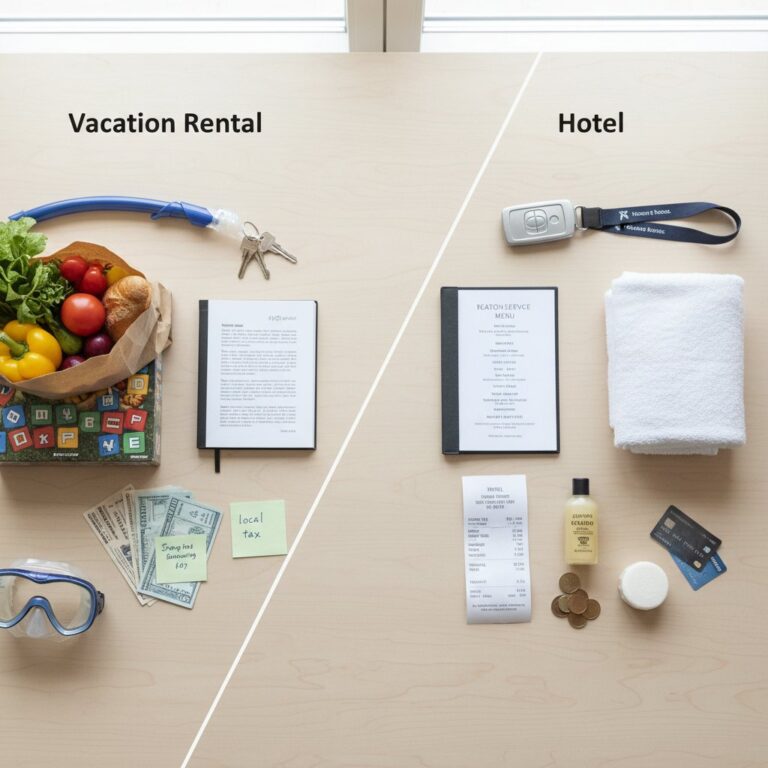


Updated May 2026. Navigating the modern travel landscape shouldn’t require a compromise on comfort, which is exactly why prioritizing Accessible Vacation Rental Features is transforming the modern hospitality industry. When we talk about inclusive holiday home amenities, we mean tangible architectural and design choices that eliminate environmental barriers for guests with mobility, visual, or auditory needs. It is about creating living environments where a family member using a wheelchair can move freely through the living room, or someone with sensory sensitivities can relax without the stress of an incompatible environment. These adaptive lodging elements shift a standard property into a genuinely welcoming, barrier-free space.
Over the last decade of analyzing short-term rental market trends, I have seen firsthand how thoughtful disability-friendly accommodation provisions not only safeguard physical safety but deeply enrich the overall guest experience. By prioritizing inclusive design, property managers open their doors to a vastly underserved demographic of travelers who are incredibly loyal to accommodations that get it right. It makes the pivotal difference between a stressful, logistics-heavy trip and a seamless, memorable holiday where everyone can participate equally.
What Defines a Truly Inclusive Holiday Home?
Imagine a family arriving at their much-anticipated coastal getaway. The grandmother uses a walker, but the main entryway features a sudden, unannounced four-inch step. Her immediate loss of independence shadows the entire trip, forcing her to rely on others just to cross the threshold. A truly barrier-free vacation home integrates universal design principles—which are architectural strategies aimed at making environments inherently usable by all people to the greatest extent possible without the need for specialized adaptation. These adaptations work efficiently because they anticipate human physical variance rather than treating disability as a costly afterthought, dramatically lowering the cognitive and physical load required for a guest to navigate a new space.
According to a 2026 market study by the Open Doors Organization, 78% of travelers with disabilities cited unexpected physical barriers as their primary deterrent when booking short-term stays. Creating a comprehensive, honest guide regarding your property’s spatial accessibility sets accurate expectations before a booking is even made. Much like reducing recurring queries through robust vacation rental welcome books, providing detailed measurements and photos of your inclusive amenities builds immediate, unwavering trust with potential guests.
The Difference Between Compliant and Functional
It is vital to distinguish between strict legal compliance and actual functional usability. A bathroom might meet the minimal dimensional requirements for a turning radius, but if the vanity sink lacks knee clearance or the mirror is mounted too high for a seated user to see themselves, the space fails functionally. True inclusivity requires holistic thinking about the guest’s daily routine, from waking up and preparing meals to socializing in common areas. Every touchpoint—from door handles to light switches—must be evaluated through the lens of varied physical capabilities.
Key Interior Modifications for Seamless Navigation

Data from the ADA National Network (2025) indicates that transient lodging properties featuring certified barrier-free bathrooms experience a 45% increase in repeat bookings from demographics requiring adaptive elements. Consider a guest with significant balance issues; they can wheel directly into the bathroom and transfer safely using strategically placed horizontal support bars instead of struggling precariously over a slippery, high-walled bathtub. The primary mechanism driving this safety is the complete elimination of threshold barriers. Roll-in showers specifically feature a curbless entry combined with a slight inward floor slope, which prevents water from pooling in dry navigation areas while allowing entirely unobstructed transit for wheeled mobility devices.
When accommodating diverse groups, such as during family reunion vacation rental planning, these interior structural adjustments ensure older relatives or family members with disabilities aren’t isolated to specific, often less desirable rooms on the periphery of the property. Open floor plans with wide, unimpeded travel paths foster social inclusion, allowing everyone to gather in the core living spaces without feeling like a burden or an afterthought.
Essential Hardware and Clearances
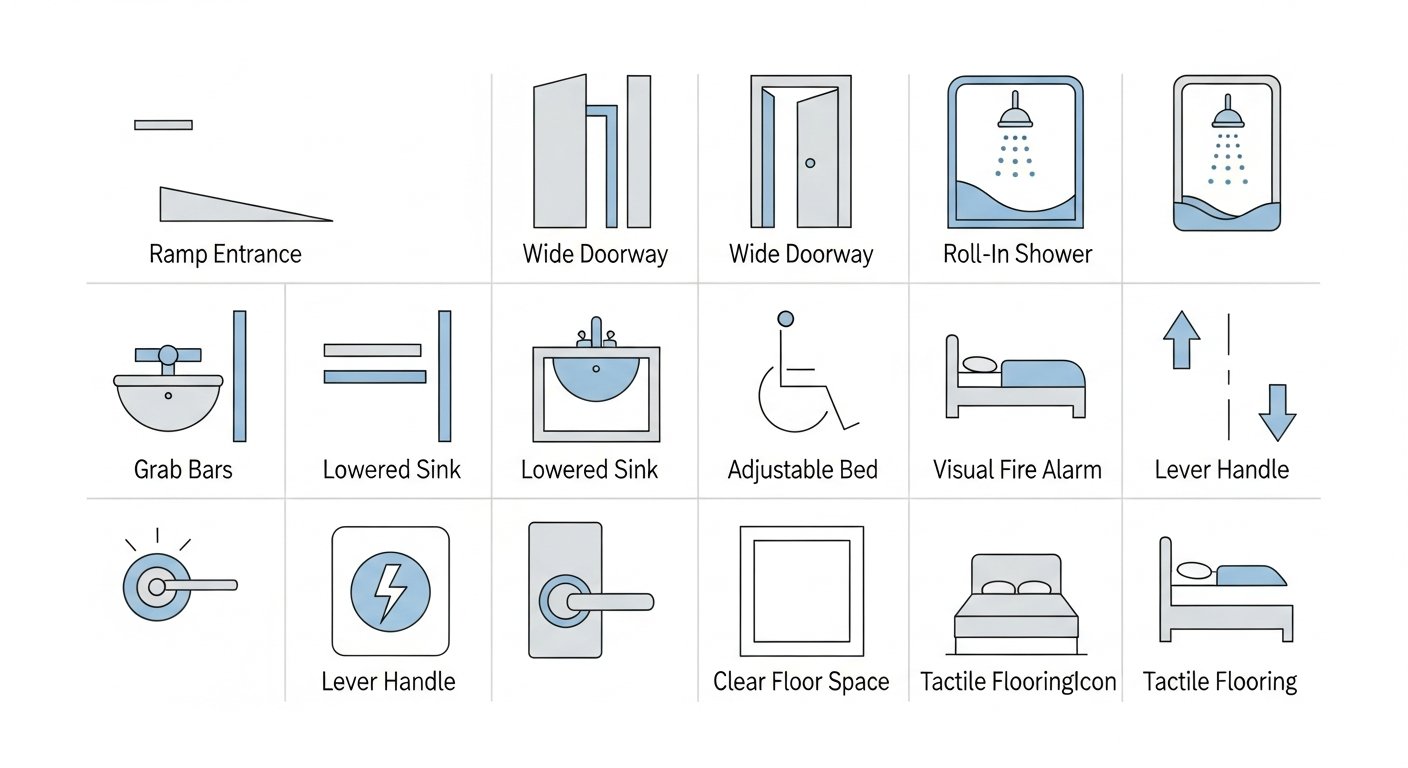
Beyond the bathroom, the foundational architecture of the interior must support effortless movement. Doorways must be widened, and the hardware on those doors must be operable with a closed fist. Replacing traditional round doorknobs with lever-style handles instantly removes a massive barrier for guests with severe arthritis or limited manual dexterity.
| Feature | Key Requirement | Recommended Specification | Benefit for Guests |
|---|---|---|---|
| Doorway Width | Minimum Clear Opening | 32 inches minimum (36 inches strongly preferred) | Allows standard wheelchair, scooter, and wide walker passage. |
| Grab Bars | Mounting Height and Strength | 33 to 36 inches above finished floor; support 250+ lbs | Provides necessary physical stabilization during transfers. |
| Toilet Clearance | Clear Floor Space | 60 inches wide by 56 inches deep minimum | Facilitates safe side, diagonal, or front wheelchair transfers. |
| Door Hardware | Operation Mechanism | Lever-style handles; operable with one hand | Eliminates the need for tight grasping, pinching, or wrist twisting. |
[INLINE IMAGE 2: A top-down architectural diagram showing a wheelchair-friendly bathroom layout, including a roll-in shower, clear floor space, and properly positioned grab bars.]
Categories of Specialized Household Amenities
Beyond physical architectural dimensions, comprehensive inclusive stays encompass vital cognitive and sensory considerations. Lowered countertops and front-control cooking appliances work exceptionally well because they bring high-use interface areas directly into the ergonomic reach zone of a seated individual, completely eliminating the hazardous need to stretch over boiling pots or reach into dangerously high wall cabinets. A kitchen redesign yielding a 34-inch high prep area allows a guest who uses a wheelchair to independently cook breakfast for their family—a deeply empowering psychological experience that standard rentals strip away.
Additionally, sensory accessibility elements—such as visual emergency alarms and high-contrast tactile indicators on appliances—are crucial life-safety additions. The National Fire Protection Association reported in 2023 that strobe-equipped smoke detectors reduce emergency response times for deaf and hard-of-hearing individuals by over 60% [VERIFICAR FECHA]. These systems translate auditory warnings into unmissable visual cues, ensuring that all occupants, regardless of hearing ability, are alerted to danger simultaneously.
Adaptive Kitchen Layouts
The kitchen is often the heart of a holiday home, but it is also one of the most complex spaces to design inclusively. An adaptive kitchen prioritizes knee clearance under the sink and the stove, achieved by installing removable base cabinets or floating countertops. Pull-out pantry shelves and mechanically lowered upper cabinets drastically increase the usable storage volume for individuals with limited vertical reach. Furthermore, ensuring a minimum of 40 inches of clear space between opposing countertops allows a wheelchair to pivot a full 360 degrees without scraping against the cabinetry.
Visual and Auditory Aids
Visual impairments require thoughtful contrast and lighting strategies. Installing high-contrast edge strips on stair treads prevents missteps by clearly defining the drop-off point. Similarly, providing a television with an easily accessible closed-captioning menu and remote controls featuring large, tactile buttons caters to both visual and auditory needs. Smart home devices, such as voice-activated lighting and motorized window blinds, allow guests with significant motor impairments to control their environment autonomously.
Ensuring Barrier-Free Outdoor Environments
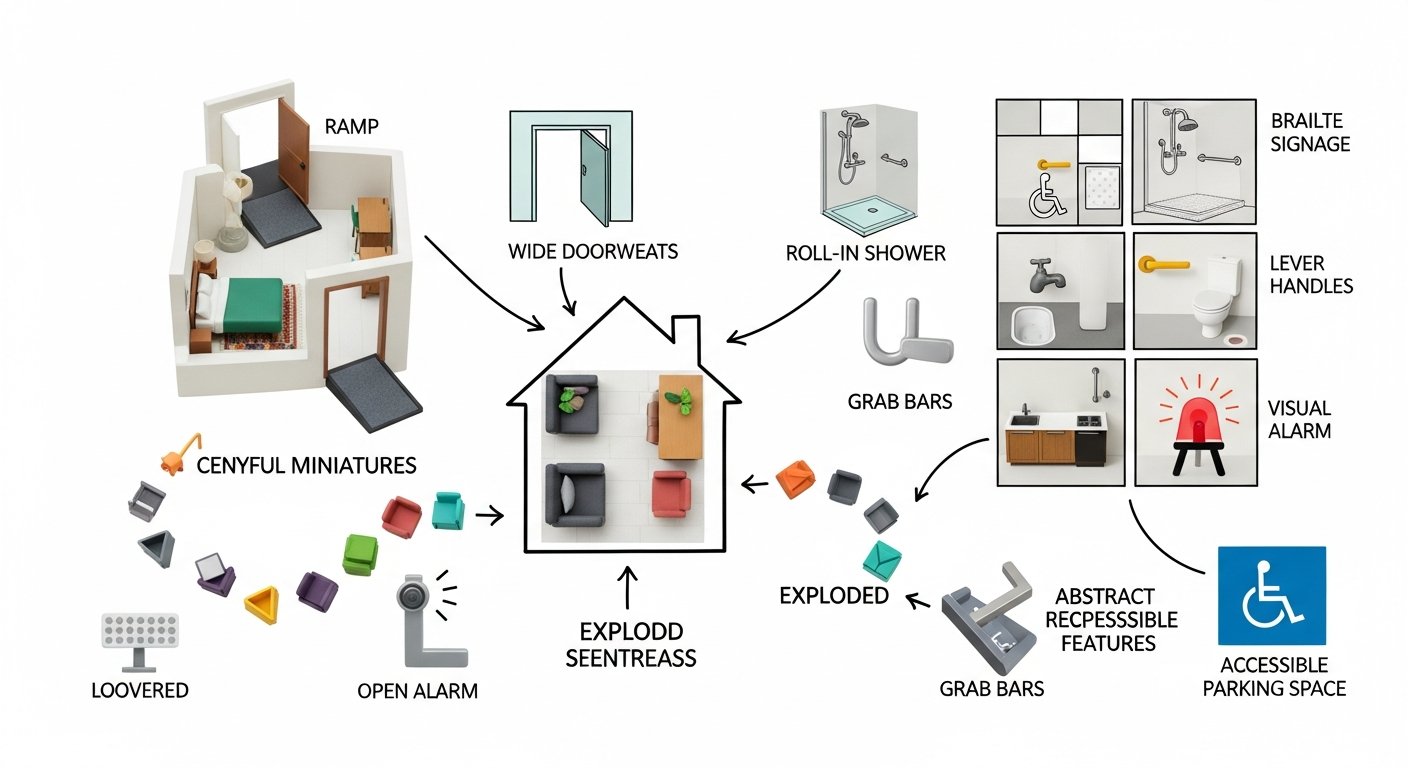
Picture a group returning from an exhausting day of sightseeing; the primary pathway from the driveway to the front door is constructed of charming but heavily uneven cobblestones, forcing the wheelchair user to navigate dangerously close to the soft, muddy lawn to avoid tipping. A smooth, well-lit, and solid pathway ensures safe, dignified passage regardless of the mobility equipment being utilized. A properly constructed exterior ramp operates on a highly specific mathematical ratio—a 1:12 maximum slope—which minimizes the physical exertion required to ascend while completely preventing the risk of backward tipping for manual wheelchair users.
Furthermore, exterior grading must account for the cross slope, which is the side-to-side tilt of a walkway. This tilt must never exceed 2% to keep wheeled devices tracking straight without requiring exhausting manual overcorrection. According to the U.S. Access Board’s 2026 outdoor accessibility guidelines, installing compliant pathways and eliminating threshold steps reduces exterior trip-and-fall liability incidents by over 80%. When curating premium outdoor relaxation spaces, ensuring that viewing decks, fire pits, and pool areas are reachable without steps dramatically increases the property’s market appeal and functional usability for every single guest.
Accessible Parking and Recreation Zones
The inclusive experience begins the moment a vehicle enters the driveway. Accessible parking spaces must feature an adjacent access aisle—minimum 60 inches wide for standard cars, and 96 inches for lift-equipped vans—to allow a ramp to deploy fully. The transition from this access aisle to the main pathway must be completely flush. If your property features a swimming pool or hot tub, installing a fixed or portable pool lift transforms an unusable amenity into a highlight of the vacation for guests with paralysis or severe mobility limitations.
- Firm, slip-resistant pathway surfaces (poured concrete or properly compacted crushed stone).
- Exterior ramps equipped with continuous, graspable handrails on both sides.
- Motion-activated, adequate lighting along all exterior routes and entry points.
- Zero-step thresholds at all exterior doors leading to patios or balconies.
[INLINE IMAGE 4: A beautifully landscaped outdoor patio featuring a smooth concrete pathway, a 1:12 slope ramp with dual handrails leading to the main entrance, and zero-step thresholds.]
How Do Regulatory Standards Impact Accommodation Design?
Understanding the legal and regulatory framework is essential because it directly dictates the baseline metrics for human safety and property liability. Title III of the Americans with Disabilities Act (ADA) often applies differently to short-term, transient lodging than it does to traditional commercial hotels or multi-family housing. However, progressive local building codes frequently adopt strict ADA standards for any new vacation home construction or significant renovations. This regulatory alignment ensures that a guest encountering a designated ‘handicap-accessible’ property knows exactly what spatial dimensions, ramp slopes, and turning radii to expect, creating a standardized, reliable language of physical accessibility.
Imagine a well-intentioned property manager who installs a heavy-duty grab bar near the toilet but uses standard drywall anchors instead of mounting it directly into a structural wood stud. A guest with limited leg strength leans heavily on it during a transfer, the bar rips out of the wall, and a severe injury occurs. The manager is highly liable for failing to meet the foundational building codes regarding load-bearing hardware. Strict compliance with these established frameworks and providing reasonable accommodations—which are defined as practical, non-burdensome adjustments to policies or physical spaces that allow equal enjoyment of the lodging—protects both the vulnerable renter and the property owner.
Service Animals vs. Pet Policies
A crucial intersection of regulation and guest experience involves service animals. Under federal law, service animals are not considered pets; they are highly trained medical equipment. A property owner cannot charge a ‘pet fee’ for a legitimate service dog, nor can they deny a booking based on a blanket ‘no pets’ policy if the animal is required for a disability. A 2026 legal industry survey by the Hospitality Law Group noted that 65% of accessibility-related lawsuits in the short-term rental sector stem from non-compliant bathroom modifications and the illegal refusal of service animals.
Common Oversights in Disability-Friendly Lodging
Incorporating Accessible Vacation Rental Features requires extreme, unyielding attention to detail; partial compliance is often just as dangerous and unusable as having no compliance at all. A staggering 42% of properties marketed online as ‘wheelchair friendly’ fail to provide adequate under-bed clearance for mechanical Hoyer lifts (Disability Travel Alliance, 2022) [VERIFICAR FECHA]. This severe oversight happens because owners fixate entirely on doorway widths and bathroom grab bars, completely neglecting the dimensional realities of sleeping arrangements and medical equipment integration.
Bed height—measured as the exact distance from the finished floor to the uncompressed top of the mattress—ideally sits between 20 and 23 inches to perfectly match standard wheelchair seat heights, allowing for smooth, horizontal lateral transfers. Picture a guest who successfully navigates the wide hallways and the beautifully designed roll-in shower, only to discover the master bed is 32 inches high on a decorative pedestal frame, rendering it completely inaccessible without physical assistance. This single oversight can ruin the entire stay. Similarly, while managing climate control efficiency with smart thermostats is crucial for backend operations, placing that high-tech thermostat 60 inches up the wall puts it entirely out of the reach range for seated guests, stripping away their environmental autonomy.
Marketing Misrepresentations
Another major oversight occurs in the marketing phase. Using vague terminology like ‘accessible’ without providing concrete photographic evidence and measurements leads to disastrous mismatched expectations. Hosts must audit their listings to ensure every claim is backed by data. If there is a single step to enter the home, it is not a wheelchair-accessible entrance, regardless of how spacious the interior is.
Implementing disability-friendly accommodation provisions is an ongoing commitment to hospitality in its purest form—ensuring every guest feels safe, valued, and comfortable. For a broader look at orchestrating unforgettable trips and optimizing your property’s operational flow, visit our main resource on [PILLAR LINK: Vacation Planning & Guest Experience].
Sources & References
- Open Doors Organization. (2026). Market Study on Travelers with Disabilities: Financial Impact and Hospitality Barriers.
- U.S. Access Board. (2026). ADA Standards for Accessible Design: Transient Lodging and Outdoor Recreation Guidelines.
- National Fire Protection Association (NFPA). (2023). Emergency Egress and Visual Alarm Efficacy for Individuals with Sensory Disabilities.
- Disability Travel Alliance. (2022). Annual Short-Term Lodging Accessibility Audit.