

Is the Wiring in Your Older Owasso Home Still Safe?
Older homes have a particular kind of charm and a particular kind of secret. Behind the plaster and the original trim, a fair number of them still run on wiring installed when a household's biggest electrical draw was a radio and an icebox. It worked then. The question for any owner of an older home in Owasso or the wider Tulsa area is whether it still works safely now, with central air, a kitchen full of appliances, and a charger in every room. Rewiring is not a small job, so it helps to know the signals that genuinely warrant it.
The wiring is from a flagged era
Two wiring types raise immediate questions. Knob-and-tube, common in homes built before 1950, runs ungrounded conductors through ceramic insulators and was never designed for modern loads. Aluminum branch wiring, widely installed between roughly 1965 and 1973 during a copper shortage, expands and contracts enough to loosen its connections over time, and loose connections generate heat. Neither guarantees the house is unsafe today, but both mean it deserves a professional look before you keep loading it.
Insurance is starting to ask questions
Carriers have tightened their stance on outdated wiring. Some now require an electrical inspection before they will write or renew a policy, and some decline coverage on active knob-and-tube circuits outright. If a renewal letter asks for electrical documentation, that is the insurer telling you the wiring is a liability in their eyes. Getting ahead of it with a planned assessment is far cheaper than scrambling during a renewal window.
Two-prong outlets are everywhere
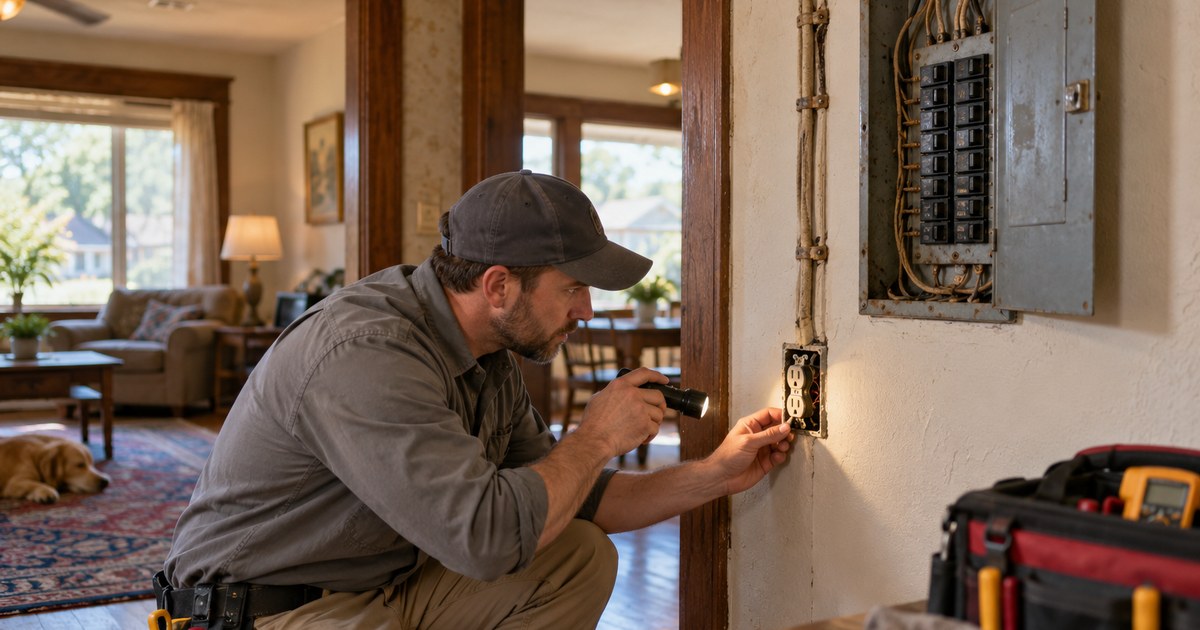
A house full of two-prong outlets is a house with an ungrounded system. Modern electronics expect a path to ground for safety, and the little adapter plugs people rely on are not a real fix. Widespread two-prong outlets usually signal wiring old enough that a broader update is worth pricing out rather than patching one room at a time.
The symptoms keep showing up
Flickering lights that are not the bulb. Outlets that feel warm. Breakers that trip without a clear cause. A faint scorched smell near a switch. Individually, any one of these can be a small fix. Together, across multiple rooms, they often point to a system that is overloaded and aging rather than a single failed component.
The panel no longer matches the house
Older homes were often built with 60 or 100 amp service. A modern household frequently needs 200 amp service and more circuits than the old panel can hold. When the panel has to grow, it is often the right moment to address the branch wiring feeding it, because doing both at once costs far less than tackling them months apart.
What a rewire involves
A whole-house rewire on an older home typically runs several days of on-site work, with permits and inspection through the local authority. The crew runs new grounded copper wiring, updates outlets and switches, and ties everything into a properly sized panel. It is disruptive for a week and then done for decades, which is the part that makes it worth the commitment.
The work should always go to a licensed Electrical Contractor, both for safety and because permitted, inspected work protects a home's value and insurability. Half Moon Plumbing and Electric has served Owasso and the Tulsa area since 2007 under Oklahoma Electrical Contractor License #00140295, pairing the assessment with a clear written estimate so owners know what they are committing to. As a back-to-back Tulsa World "Best in the World" winner for plumbing and water treatment in 2024 and 2025, the company handles whole-home rewiring in Owasso from the load calculation through the final inspection.
The bottom line
One sign on this list is worth an inspection. Several together is worth a serious conversation. The older homes that get rewired on a plan almost always come out ahead of the ones that wait for a failure to force the issue, and they stay both charming and current in the process.